How a Nuclear Weapon Would Be Delivered
A warhead is only half of a nuclear weapon. The other half is the thing that carries it to the target, and that choice decides almost everything a simulation cares about: how much warning there is, how big the warhead can be, whether it detonates in the air or on the ground, and whether the attack can be called off after it starts.
The short answer
If nuclear weapons are ever used again by a state, a missile is the most likely carrier. Counting the strategic warheads that sit on active delivery systems, something like 85 to 90 per cent ride on ballistic missiles, split between land-based silos and submarines; nearly all of the rest are carried by aircraft. But the first use in a modern conflict would not necessarily be strategic. The scenario most often discussed by analysts is a single low-yield weapon delivered by a short-range missile or an aircraft, not a mass exchange of intercontinental missiles.
Land-based ballistic missiles
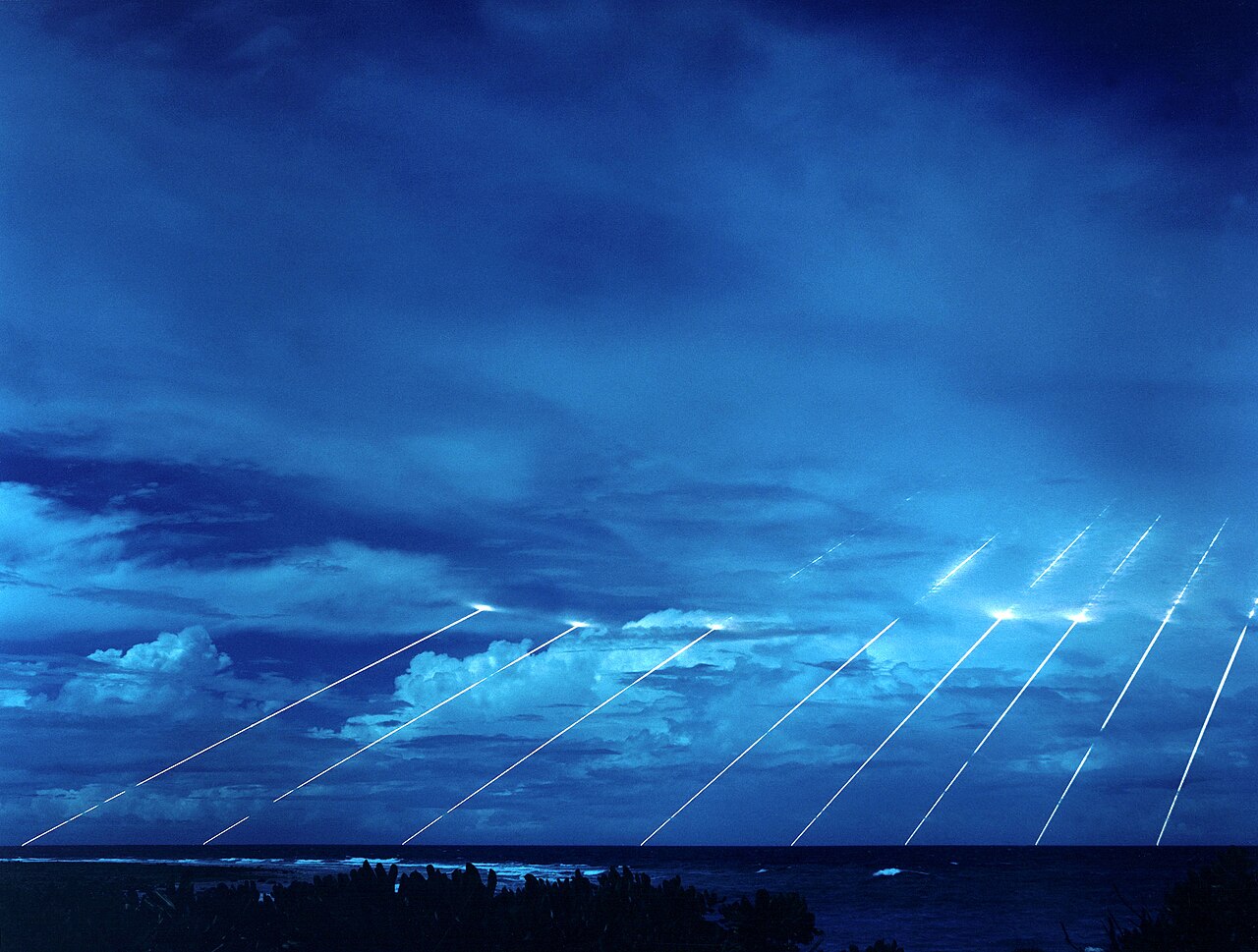
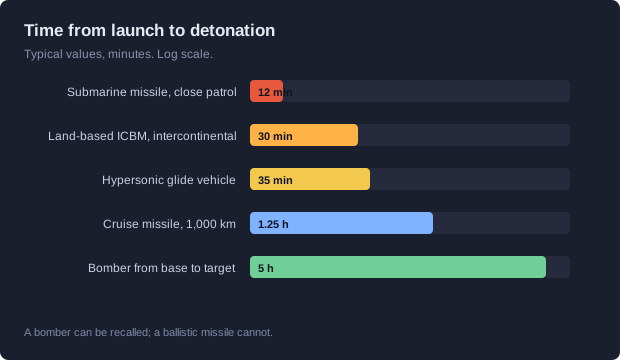
These sit in hardened silos or on mobile launchers that drive through forests and deserts to complicate targeting. The missile burns for a few minutes, coasts through space, and its warheads re-enter the atmosphere at several kilometres per second. Flight time between continents is roughly 25 to 35 minutes. There is no practical defence: a modern missile releases multiple warheads plus decoys, and every interceptor has to work in minutes.
Silo fields are also the main reason ground bursts get modelled at all. Against a city an airburst does far more damage, but a silo has to be hit by a warhead that detonates at or near the surface — which is what produces heavy local fallout.
Submarine-launched missiles
A ballistic missile submarine is the most survivable leg of any arsenal: once it is at sea, nobody reliably knows where it is, which is what makes a retaliatory strike credible. The United Kingdom keeps its entire arsenal this way, and France keeps most of its own there. Flight times can be shorter than for land-based missiles, because a submarine can be closer to the target than any silo.
Aircraft: gravity bombs and cruise missiles
Bombers are slow, and a bomber can be tracked, intercepted and — crucially — recalled. That is exactly why they are useful: moving them is a visible political signal that can be reversed. Their weapons come in two forms. A gravity bomb such as the American B61 is released over or near the target; the modern versions have a guidance kit and a selectable yield, from a fraction of a kiloton up to a few hundred. An air-launched cruise missile flies low and subsonic for hundreds or thousands of kilometres, which makes it interceptable in principle but hard to see on radar.
Non-strategic weapons
Short-range missiles like the Russian Iskander, sea-launched cruise missiles and tactical aircraft bombs make up the so-called non-strategic arsenals. Yields are usually in the range of a few kilotons to a few hundred. These are the weapons in nearly every plausible first-use scenario: one warhead, a battlefield or a single city district, meant as a demonstration rather than as a disarming blow. The simulator has an Iskander warhead among its presets, and 50 kt over a dense district is already an order of magnitude worse than Hiroshima: try it on Warsaw or any city you know.
Newer systems
Hypersonic glide vehicles are launched by the same ballistic missiles but flatten their trajectory and manoeuvre on the way down, which complicates both tracking and interception. Russia has also publicised a nuclear-powered cruise missile and a very large nuclear torpedo intended to attack coastal targets. For a simulation none of this changes the picture on the ground: what matters is the yield and the height of burst, not the vehicle that delivered it.
A weapon that arrives by truck
The one delivery method that has nothing to do with missiles is a device smuggled into a city by vehicle, container or boat. This is the terrorism scenario, not the state one: the yield would be small, perhaps 1 to 10 kilotons, and the detonation would necessarily be at ground level, which means a smaller blast radius than an airburst of the same size but much heavier local fallout. The Improvised HEU device and crude terrorist weapon presets in the simulator cover this case; pair either with the surface burst option.
What this changes on the map
- Height of burst matters more than the carrier. Against a city, planners choose an airburst: it widens the ring of severe damage and leaves little local fallout. Against a silo or a deep bunker, the warhead goes off at the surface, with the opposite trade. In the simulator this is the Air burst / Surface burst switch, and the difference in the results is dramatic.
- Real attacks are not one warhead. A large city would be assigned several warheads aimed at different points, not one bomb on the centre. The Multiple detonations mode shows what that looks like.
- Accuracy is irrelevant for cities and decisive for silos. Modern missiles land within a few hundred metres of the aim point; against a city that barely changes the damage map, while a hardened silo either gets hit or survives. The advanced options include a circular error probable setting for exactly this.
- Warning time is the human part. Thirty minutes is the difference between a decision made by people and a decision made by procedure. It is also, for anyone underneath, the difference between taking shelter and being caught in the open.
Further reading
For how the warheads themselves work, see how nuclear weapons work. For what the explosion actually does, see effects of a nuclear explosion, and for who owns what today, nuclear arsenals of the world. Warhead and delivery counts in this article are open estimates published by independent researchers such as the Federation of American Scientists and SIPRI; governments do not confirm them.
