Nuclear Fallout: What It Is and How Long It Lasts
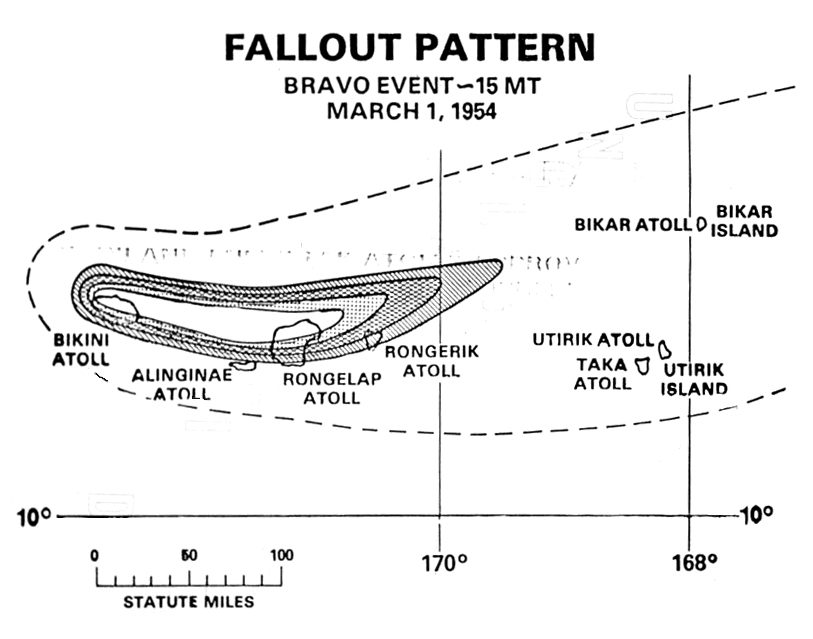
On 1 March 1954 the crew of a Japanese tuna boat, the Daigo Fukuryū Maru, saw a light rise in the west and heard a roar several minutes later. About two hours after that, a fine white ash began to fall on the deck. Nobody on board knew it came from Castle Bravo, a 15-megaton American test on Bikini Atoll some 140 kilometres away. Within days the 23 fishermen had burns and nausea, and the boat's radio operator died that September. On the inhabited Rongelap Atoll the same ash fell into drinking water and on children's hair; its people were evacuated only two days later.
That ash is what nuclear fallout looks like: ordinary dust and debris made radioactive by the explosion and dropped back to earth by the wind.
Where fallout comes from
A nuclear explosion leaves behind fission products, hundreds of different radioactive atoms, along with traces of unburned fuel. On their own they would rise with the hot cloud and drift around the planet in tiny amounts. The danger comes when the fireball touches the ground. It then sucks up thousands of tonnes of soil, rock and building material, melts some of it, and the radioactive atoms stick to the particles. Sand-sized grains fall out within an hour or two close to the blast. Finer dust is carried tens or hundreds of kilometres downwind before it settles.
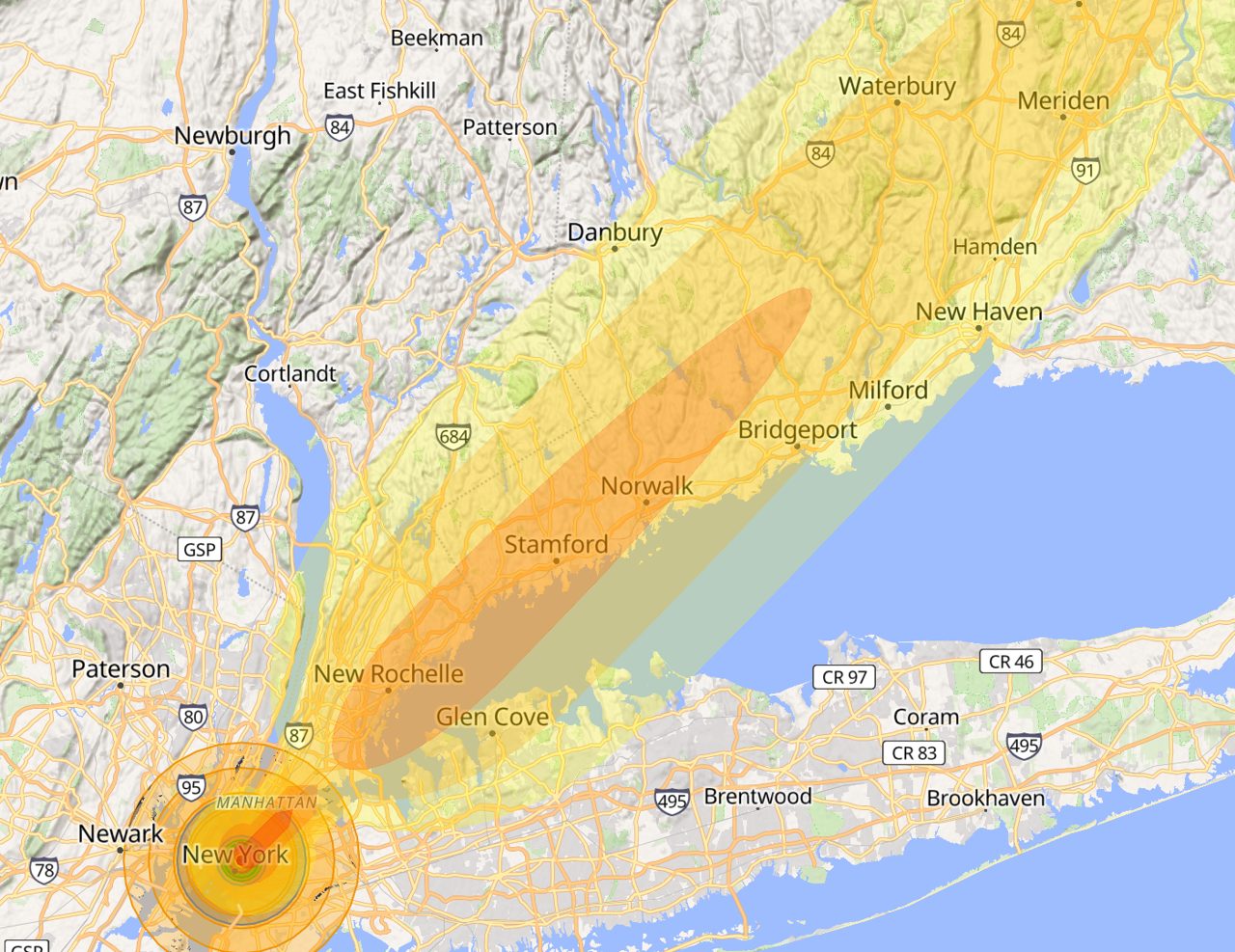
An airburst whose fireball never reaches the ground leaves very little local fallout. That is why Hiroshima and Nagasaki, both airbursts, killed overwhelmingly through blast and heat, and why a surface burst on the same city would leave a long contaminated trail behind it. In the simulator you can switch to a surface burst and turn on the fallout plume to see the difference.
The 7:10 rule
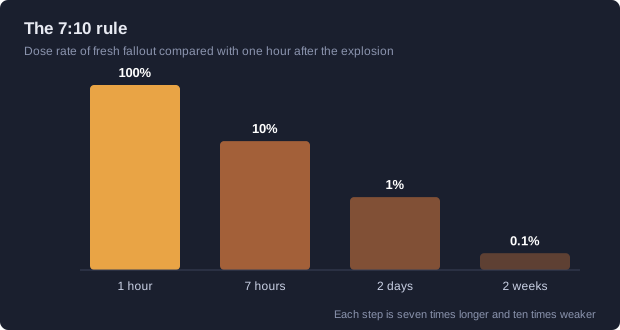
Fallout is fierce at first and weakens fast, because the most radioactive fission products are also the shortest-lived. Civil defence planners use a rule of thumb: for every sevenfold increase in time after the explosion, the dose rate drops tenfold.
- 1 hour after the burst: 100% (the reference level)
- 7 hours: 10%
- 49 hours, about two days: 1%
- 2 weeks: 0.1%
The practical lesson is simple and well tested. The first hours matter most. Someone who stays under good shielding for the first day avoids most of the dose they would have received outdoors over the following weeks.
How much shelter helps
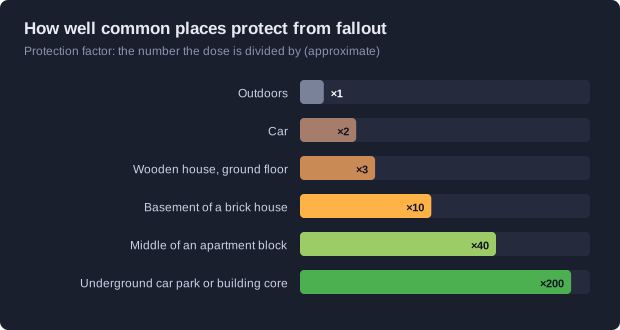
Radiation from fallout on roofs and on the ground is mostly gamma rays, which lose strength passing through mass: earth, concrete, brick, distance. Planners rate a shelter by its protection factor, the number by which it divides the dose. A car offers almost nothing. The basement of a brick house divides the dose by about ten. The core of a large concrete building or an underground car park can divide it by a few hundred.
Inside any building, the best place is as far as possible from the roof and the outside walls, and below ground if there is a basement. Fallout lands on surfaces, so the middle of a large building puts many walls and floors between you and it.
What lasts
A few fission products outlive the first weeks and cause most of the long-term harm. Iodine-131, with a half-life of eight days, collects in the thyroid, usually through milk. Strontium-90 and caesium-137, with half-lives of about 29 and 30 years, behave like calcium and potassium in the body and in food chains. In the late 1950s a survey in St. Louis collected hundreds of thousands of children's baby teeth and found strontium-90 from atmospheric testing in them. Those findings helped push the United States, the Soviet Union and Britain to sign the 1963 treaty that moved nuclear testing underground, a story told in the history of nuclear testing.
For what to do if fallout is expected, see how to survive a nuclear attack.