Hydrogen Bomb vs Atomic Bomb: the Difference Explained
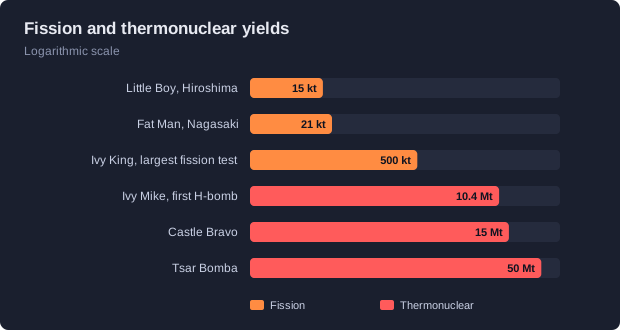
An atomic bomb gets its energy by splitting heavy atoms. A hydrogen bomb gets most of it by fusing light ones, and it needs an atomic bomb inside it to start. That is the short answer. The practical difference is power: the two bombs used in war in 1945 released 15 and 21 kilotons, while the first hydrogen bomb, tested seven years later, released 10,400 kilotons.
| Atomic (fission) bomb | Hydrogen (thermonuclear) bomb | |
|---|---|---|
| Reaction | Heavy nuclei split in a chain reaction | Light nuclei fuse, plus a lot of fission |
| Fuel | Uranium-235 or plutonium-239 | Lithium deuteride and tritium, with a fission trigger |
| How it starts | Conventional explosives assemble a critical mass | An atomic bomb (the primary) ignites the fusion stage |
| Typical yield | 1 to tens of kilotons; the largest test was 500 kt | Hundreds of kilotons to megatons; 50 Mt tested |
| First test | Trinity, July 1945 | Ivy Mike, November 1952 |
| Used in war | Hiroshima and Nagasaki | Never |
Splitting and fusing
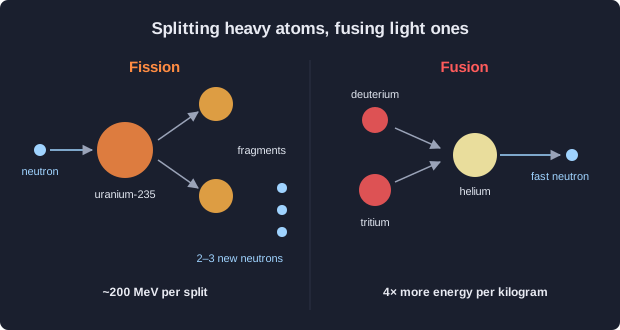
When a neutron strikes a nucleus of uranium-235 or plutonium-239, the nucleus breaks into two lighter fragments and throws off two or three new neutrons. With enough material packed tightly in one place, those neutrons split more nuclei, and the number of fissions doubles roughly every hundredth of a microsecond. The whole release takes less than a millionth of a second.
Fusion runs the other way. Nuclei of heavy hydrogen, deuterium and tritium, are forced together into helium, and the mass lost in the process turns into energy. Kilogram for kilogram, deuterium-tritium fusion releases about four times as much energy as fission of uranium. The catch is the temperature: tens of millions of degrees, which no chemical explosive can produce.
Why a hydrogen bomb contains an atomic bomb
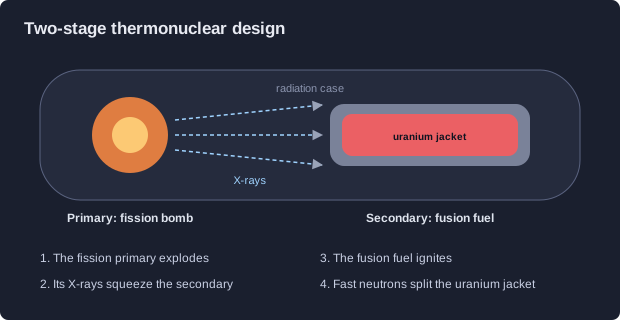
The only practical source of the heat needed for fusion is a fission explosion. In the two-stage design worked out by Edward Teller and Stanisław Ulam in 1951, a fission bomb called the primary goes off first. Its X-rays, moving at the speed of light, flood the casing and squeeze the second stage before the blast can tear the weapon apart. The compressed fuel ignites.
The secondary is wrapped in uranium, and the flood of fast neutrons from fusion splits that uranium as well. In many thermonuclear weapons about half of the total yield comes from this last fission step. So the name «hydrogen bomb» is only half true: it is a fission, fusion and fission bomb.
From 1945 to 1952
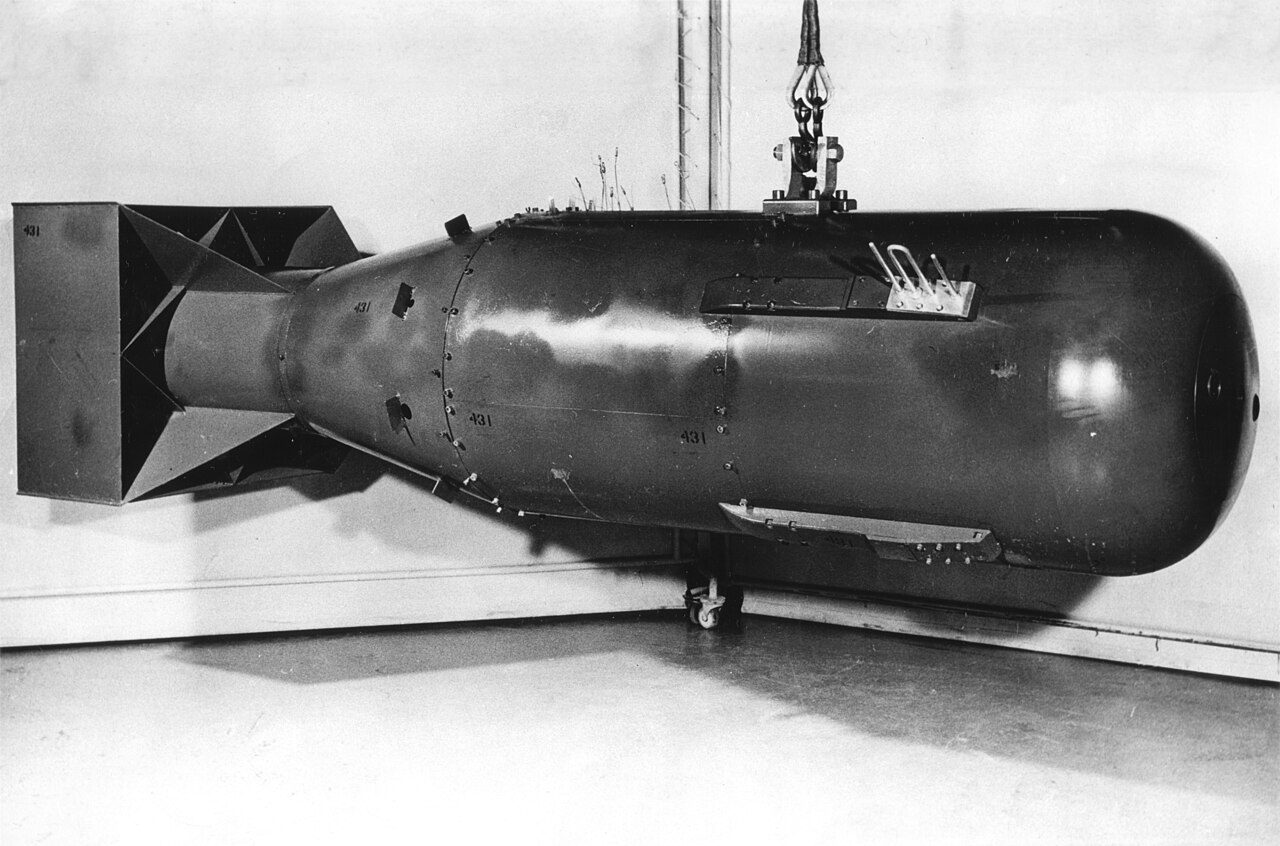
The fission bomb was the product of the wartime Manhattan Project. Hiroshima was destroyed by a uranium gun design that had never been tested; Nagasaki by a plutonium implosion bomb identical to the Trinity device. Fission bombs grew quickly after the war, but they ran into a ceiling. The more fissile material you put in one weapon, the harder it becomes to keep it from reacting too early. The largest pure fission bomb ever tested, Ivy King in 1952, yielded 500 kilotons.
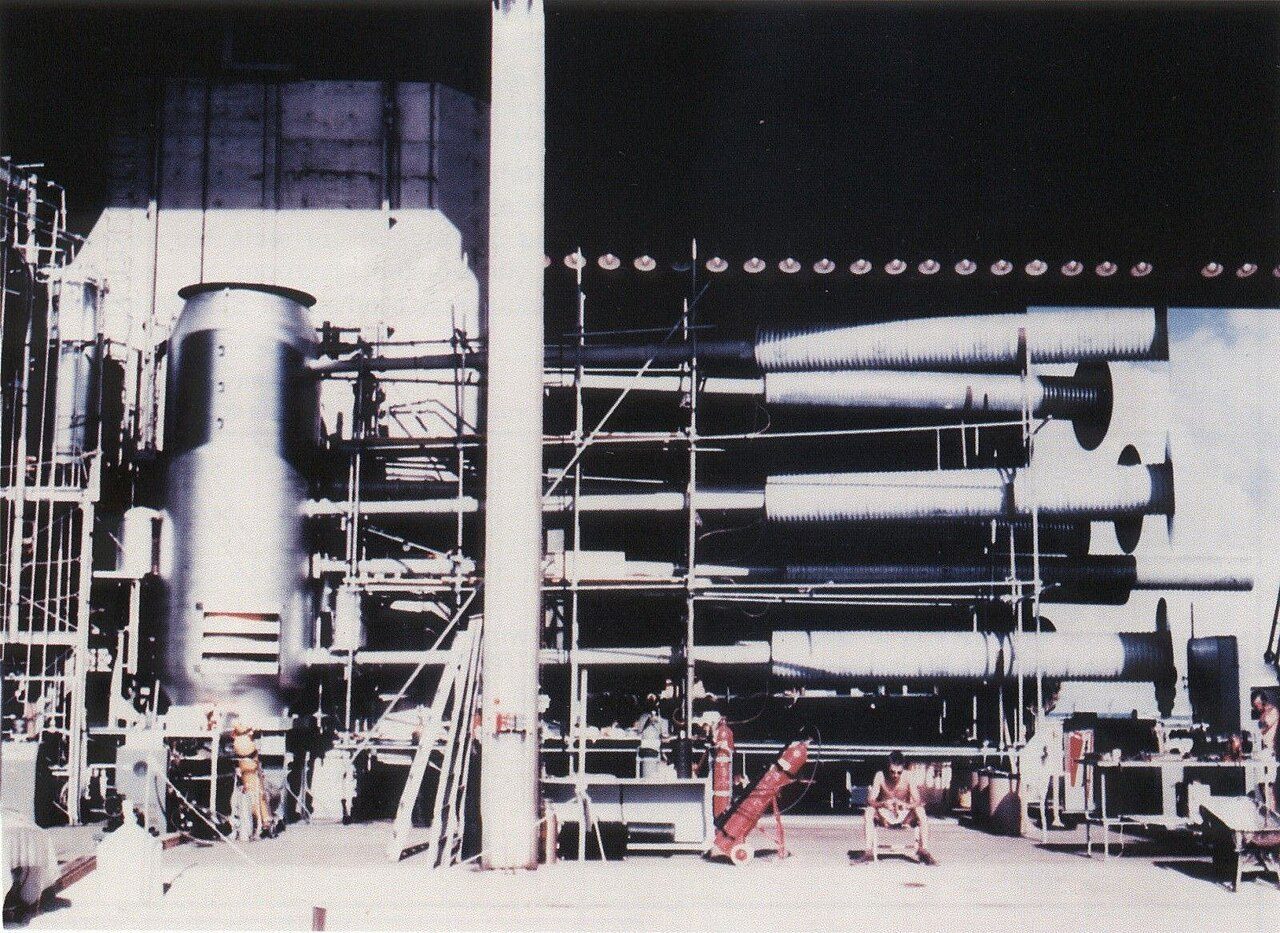
Two weeks earlier the United States had tested Ivy Mike, a 74-tonne refrigerated apparatus filled with liquid deuterium. It produced 10.4 megatons and erased an island. Within two years the liquid fuel had been replaced by solid lithium deuteride, and the hydrogen bomb fitted in an aircraft. A true Soviet two-stage weapon followed in 1955, Britain in 1957, China in 1967 and France in 1968.
What sits in arsenals today
Almost every strategic warhead deployed by the United States, Russia, Britain, France and China is thermonuclear. The design has another advantage besides raw power: it is efficient. A modern two-stage warhead weighing a few hundred kilograms yields several hundred kilotons, which lets one missile carry several of them. Pure fission weapons remain the starting point for new nuclear states, and the primaries of modern warheads are themselves fission devices boosted by a small charge of deuterium-tritium gas.
Common mix-ups
Is a nuclear bomb the same as an atomic bomb? «Nuclear weapon» covers both kinds. «Atomic bomb» is usually reserved for fission weapons.
Is a hydrogen bomb more radioactive? Not necessarily. Fallout depends mostly on how much fission takes place and on whether the fireball touches the ground. A clean design with little uranium in the secondary produces less fallout per kiloton; a high-yield surface burst produces a great deal.
Can a hydrogen bomb be made arbitrarily large? In principle the stages can be chained; the Soviet Tsar Bomba used three and was designed for 100 megatons. In practice there is no military use for such a weapon, as the story of the Tsar Bomba shows.
To compare the two kinds on a map, choose Little Boy and then a modern 800-kiloton warhead in the simulator. The details of each design are covered in how nuclear weapons work.