









How Nuclear Weapons Work
A nuclear weapon releases energy not from chemistry, like TNT, but from the nucleus of the atom itself. A single warhead the size of a refrigerator can release more energy than all the bombs dropped in the Second World War combined. There are two basic mechanisms: fission and fusion.
Fission: splitting heavy atoms
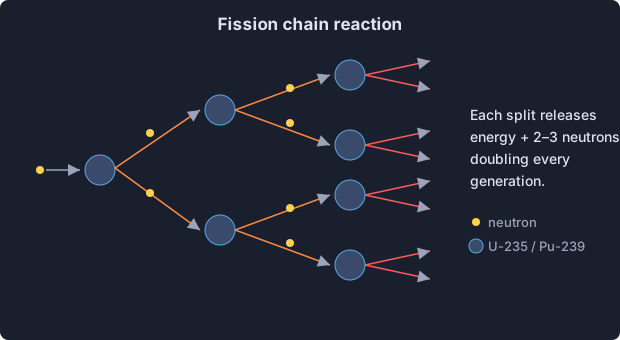
Certain heavy isotopes — uranium-235 and plutonium-239 — split into two lighter fragments when struck by a neutron, releasing energy and two or three fresh neutrons. If enough material is packed close enough together (a critical mass), those neutrons trigger further fissions and the reaction grows exponentially: some 80 generations of doubling happen in less than a microsecond.
The engineering problem is keeping the material subcritical until the moment of detonation. Two solutions were built in 1945:
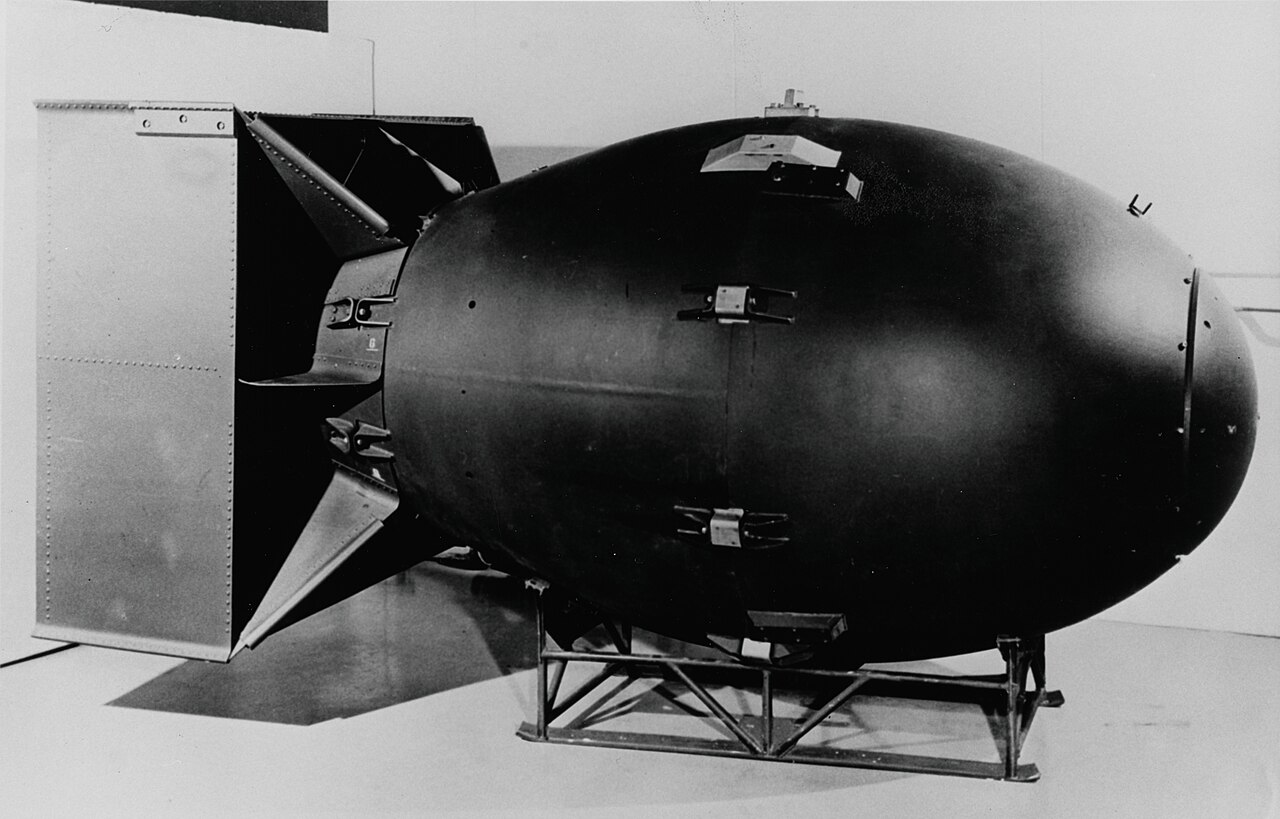
- Gun-type: one piece of uranium is fired down a barrel into another. Simple and so reliable it was never fully tested before use — this was Little Boy, the ~15-kiloton Hiroshima bomb.
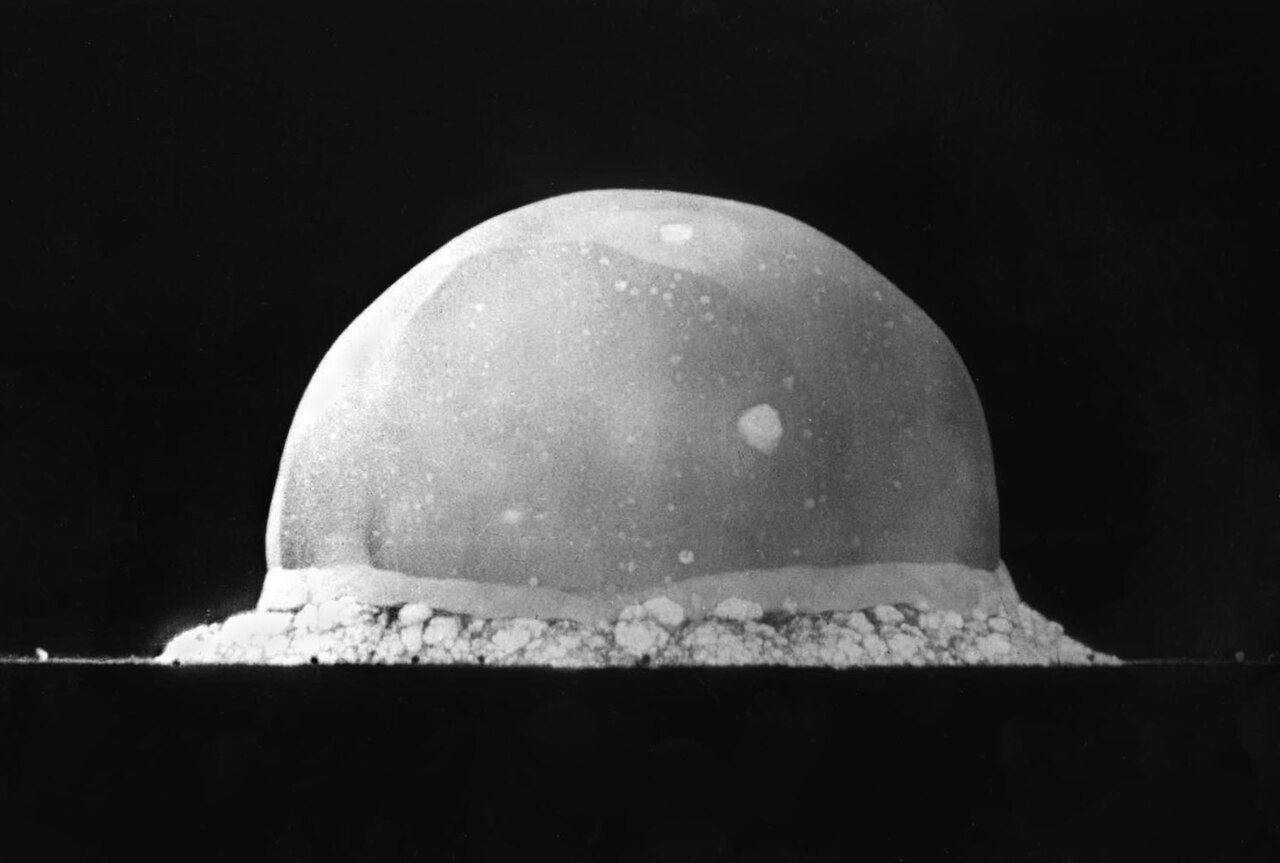
- Implosion: a sphere of plutonium is crushed to supercriticality by precisely timed conventional explosives. This design was proven at the Trinity test and used in Fat Man over Nagasaki.
Pure fission weapons top out at several hundred kilotons — the largest ever tested, Ivy King, yielded about 500 kt.
Fusion: the thermonuclear leap
Fusion joins light nuclei — deuterium and tritium — releasing even more energy per gram, but it needs temperatures of tens of millions of degrees. The only practical match is a fission bomb itself. In the staged Teller–Ulam design, a fission «primary» fires first, and its X-rays compress and ignite a physically separate fusion «secondary» before the bomb blows itself apart. Stages can in principle be chained indefinitely, which is how the Soviet Union reached 50 megatons with the Tsar Bomba.
Most modern warheads are two-stage thermonuclear designs, usually boosted: a few grams of deuterium-tritium gas injected into the primary sharply raises its efficiency, allowing warheads to be small, light and safe while still yielding hundreds of kilotons.
Why modern warheads are «smaller»
Cold-War missiles were inaccurate, so superpowers compensated with multi-megaton warheads. As guidance improved, accuracy replaced brute force: a typical deployed strategic warhead today — like the American W88 (455 kt) or the Russian Topol warhead (800 kt) — is far below the multi-megaton monsters of the 1960s, and one missile now carries several independently targeted warheads (MIRV) instead of one huge one.
See the difference yourself
The best way to grasp what these numbers mean is to compare them on a map: try the 15-kt Hiroshima bomb, then a modern 800-kt Topol warhead over Washington, then the 50-megaton Tsar Bomba — all in the simulator. How the destruction actually happens is covered in effects of a nuclear explosion.